The Border Between Books

Schlock Mercenary is a long form comic strip in which the fifteen years of daily updates are all part of the same continuity. That continuity is broken up into books, in large measure because I don’t expect anybody (not even me) to keep track of all the things that happened in the last 15 years of strips in order to enjoy the things happening this week.

When I start a new book, I reset some of the narrative “rules.” “New story” things start happening. We begin an all new set of dramatic and character arcs. If you’re blazing through the archives one click at a time, you’re going to miss this. With the current site design that can’t really be helped. If you’re reading the books in print, your arrival at the last page is a very strong signal that we’ve finished a story.

Today we sit at the boundary between Book 15 and book 16, and I created a “THE END” graphic and a “NEW BOOK STARTS HERE” graphic to try to communicate that. But what does the boundary mean? Here are the implications, with bullets:

  • Questions I left hanging in the last book are not on the front burner right now. Before I can answer them, I would have to ask them again.
  • Characters from previous books who are going to be important in this story will be introduced, or at least mentioned, fairly early on. This holds true for ships, locations, technologies, and events, as well.
  • The previous book’s themes are a closed matter. Delegates and Delegation is done saying what it had to say. Big Dumb Objects will open its own thematic discussion. If themes from previous books are going to be echoed, they’ll be reintroduced in order to prevent confusion.

You don’t have to read Schlock Mercenary in any particular way, and you certainly aren’t required to get out of it what I put into it (something I honestly don’t expect to happen very much.) Your reaction to a story–any story–is yours, and is based as much on who you are as on what’s in between the first and last pages of the story.

If, however, you want some clues as to how a story will unfold, it’s helpful to understand the form in which the creator is working. For Schlock Mercenary, that means observing the border between the books, and knowing that while the rules of the universe remain the same, each of these books has its own beginning, middle, and end.

As much as I’d love to start filling page after page with commentary about the stories I write, I’m going to leave that project for another day. For now, if you’ve got questions about the story, you’re supposed to. You’re on Page One. Everything is a question, including “what are the questions?”

I’ll do my very best to entertain you with the questions, the answers, and all the misery, misdirection, and mayhem that fall between them. This is my job, after all. And speaking of that, I need to get back to work…

Home

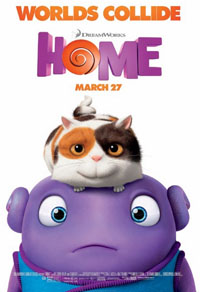
HOMEI really liked Home, though it surprised me straight out of the gate with an unexpected, and pretty hard-to-swallow premise: the aliens invade and relocate the humans to Australia, and the human military is nowhere to be seen.

To quote Harrison Ford, on the set of Star Wars when Mark Hamill had a continuity concern, “Hey, kid… it ain’t that kind of movie.”

So… my expectations were set very early on, and then the movie proceeded to do wonderful things. I had a great time. Rihanna performed brilliantly as Tip, and Jim Parsons managed to sell “deep and meaningful” while nailing “silly” in his voicing of Oh.

I’ll admit, things were just a little too “tidy” for my tastes (How to Train Your Dragon spoiled me) but the film was delightful, and not only clears my Threshold of Awesome, it scoots every other film down a notch by being the most fun I’ve had in the theater so far this year.

Insurgent

I didn’t see Divergent (the first movie in the trilogy of which Insurgent is the second) because I found the whole premise too ridiculous to swallow, and while I like a single-threaded thought experiment as much as the next person (read: “they’re okay, but can I see the dinner menu?”)  the film itself didn’t look like it was going to reward my patience.
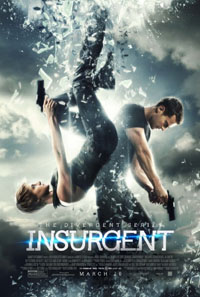
InsurgentInsurgent, on the other hand, put some really cool visuals on display in the trailers. Also, the local IMAX has $5.00 showings on Tuesdays. I decided that for $5.00 I would shell out two hours for the chance to see those visuals all big and pretty-like.

The movie took far too long to get to them.

The story being told by the film, the CORE story, the protagonist’s journey, could have been told very well in a tight, 88-minute film that showcased not just the special effects, but also the impressive range of emotion that Shailene Woodley can bring to the screen.

Instead, it did what book-to-film transductions usually do — it compressed the story of the book, fulfilling some promises made in the prior stories, and including along the way a big pile of stuff that didn’t really matter to the core story of the film itself.

I understand completely the drive to be epic in scope, but for me an epic needs to have more foundation than an absurd premise–and when I say “absurd” I don’t mean “fantastical” like rockets and ray-guns, or dragons and dwarves. I mean “absurd” like “let’s pretend human nature works THIS way instead.”

Ultimately, for me, Insurgent commits the venial sin of taking an extra 30 minutes to tell a story, and spending those 30 minutes wandering a crumbled-concrete wasteland that has long since lost its appeal (sometime before Fallout: New Vegas, I think. I need to check a calendar.) It comes in #4 for me fun-wise this year, but it does not clear the Threshold of Awesome.


On a semi-related note of clumsy silliness, I really liked the music, but when I went shopping for it I accidentally bought the Divergent score, by Junkie XL, who I had never heard of. It sounded kind of thin. It wasn’t bad, but it wasn’t what I’d remembered.

Then I realized my mistake, and went back to Amazon and bought the Insurgent score, by Joseph Trapanese. It sounds wonderful.

(Note: These are the film scores, not the soundtracks with the pop tunes on them.)
That One YA Dystopia With The Ridiculous Premise

You know that one YA novel? The dystopia with the ridiculous premise? Well, my fourteen-year-old daughter was given an assignment to write a similar sort of story. Specifically, the assignment was as follows:

Create a dystopia in which one of the rules of our society is either no longer a rule, or is enforced to an extreme. Write a story* in this setting.

(*I do not know what word-count was assigned, but I’m going to assume it was something less than novel-length.)

I struggle to enjoy that one YA novel with the ridiculous premise, but as assignments for fourteen-year-olds go, this is pretty awesome. “Take a piece of our world and change it. Now pour enough thought into it that you can tell an actual story.” I like assignments that require synthesis rather than regurgitation, and to me this is the very best kind.

I’ve recently made peace with the ridiculous premise of that one YA dystopia, but only by treating it as a thought experiment played out as a story, and designed to capture the imagination of the reader. The reader can then play out the same sort of world building exercise my daughter was assigned, and begin thinking about how our world might actually change in the future,  mulling over the full suite of implications rather than going all in on one ridiculous premise. It’s not prognostication, or futurism, but it builds the brain-muscles required for that sort of activity.

The pot is totally calling out the kettle for its fire-blackened state here, of course. I write comedic social satire wrapped in a future that is “plausible” in the same way that distilled water is a useful construction material. I have to carefully maintain some conditions, and occasionally throw some blinders on the the reader in order to prevent them from melting the whole thing down.  But this very exercise shows me exactly where the blinders are when I’m consuming that one YA dystopia, and I’m not very far into it before I realize that the scaffolding of the world has turned into a puddle, and now I’m sitting in it.

I appreciate how much thought got poured into that puddle, but that doesn’t mean I have to love having wet pants.

Writer, Illustrator, Consumer