Category Archives: Journal

This is me rambling about me, mostly. Current stuff: home, family, my head’s on fire… that kind of thing. This also includes everything imported from LiveJournal.

Technocane

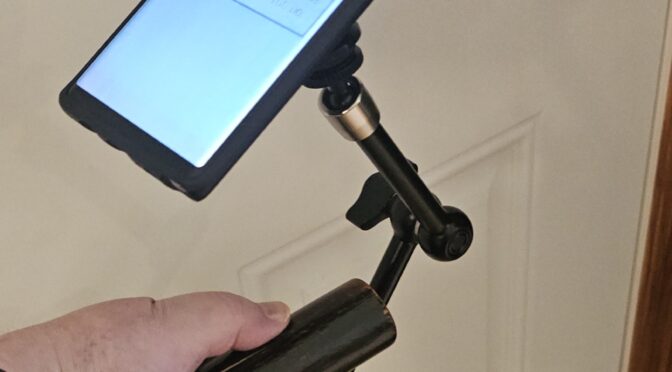
The Technocane is what happened when, in my own words, “I taught my stick how to carry my phone so that my phone would teach me to never leave home without my stick.

This page is a parts list and a quick instruction set for building your own.¹

The Type I Technocane

The simplest Technocane to build is the Type I: take a cane or walking stick that already fits your hand, your height, and your needs, and simply attach a piece to it to carry your phone. Here are the parts you’ll need:

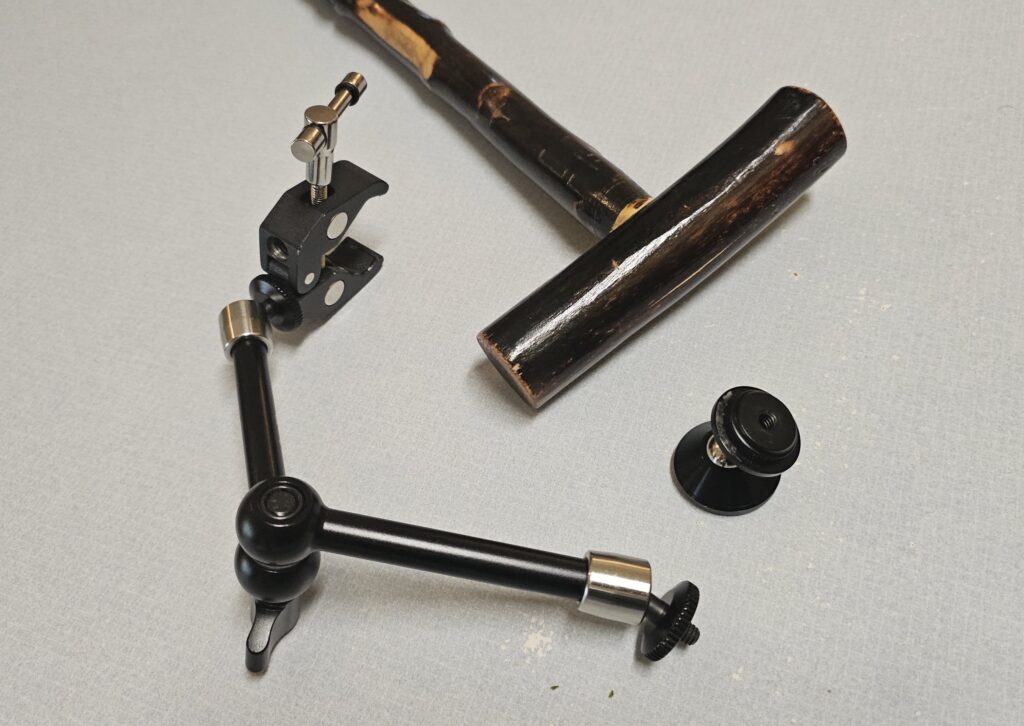
A wooden cane, a SmallRig Magic Arm with a C-Clamp, and a Coolpow  phone magnet with a thumbnut glued to one end.

You’ll also need some simple tools

  • Superglue (you’ll only need a couple of drops)
  • Hobby Knife or File or Box Cutter (to improve the glue bond)
  • Pliers (depending on your hand strength you may or may not need these)

Summary of What’s Coming

It’s pretty simple. You’re going to remove the tape from the dashboard mount, glue the thumbnut to it, and screw that assembly to one end of the Magic Arm. The other end of the arm clamps to your cane, and the rubber band gets wrapped around the clamp lever to keep it from rattling. And that’s it. Now, the details:

Instructions: Mag-mount Prep

Before beginning, make sure that your phone case will securely mount magnetically to the Coolpow component. If it won’t there’s no point proceeding until you have a phone case that will work².
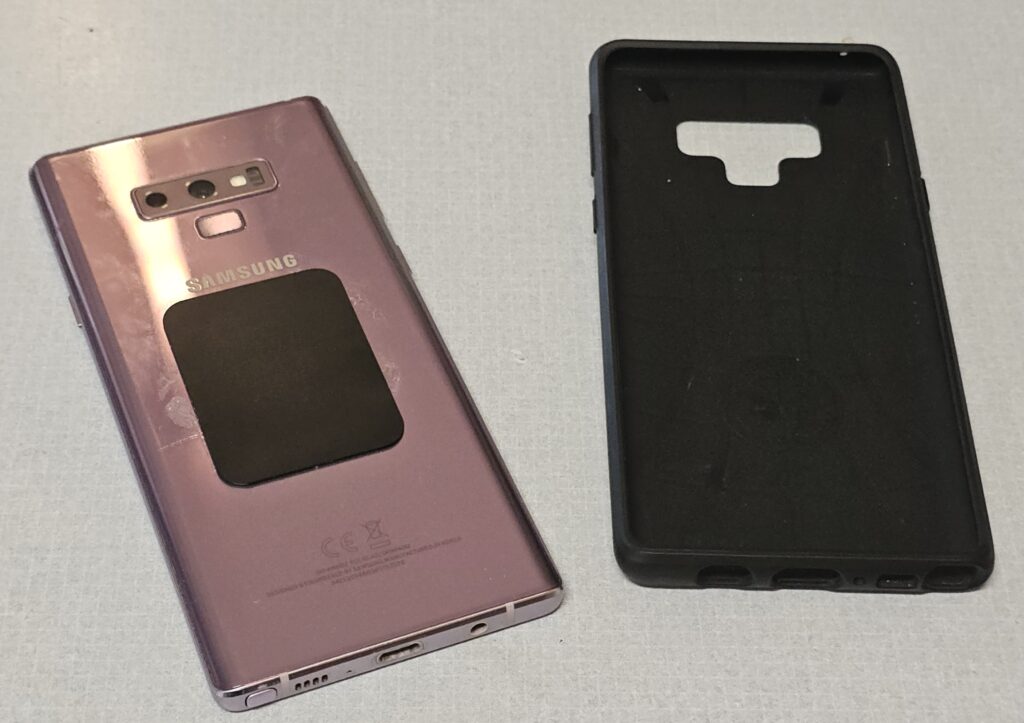
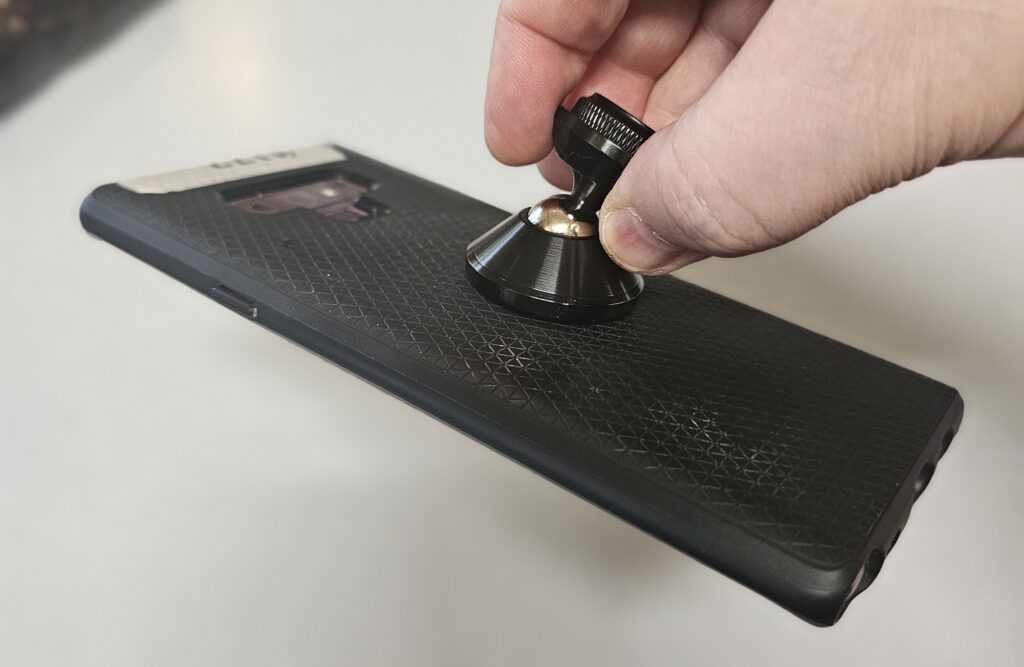
  1. Remove the tape. Take the Coolpow mount and peel all the sticky backing off of the side that attaches to the dashboard. This takes about five minutes, and is easily the most tedious part of the entire project.
  2. Score the mount: With your knife, file, or cutter, carefully score the now tape-free dashboard side of the mount. Lots of little lines in a couple of directions.
  3. Score the nut: Score one side of the metal thumb nut, same as with the mount.
  4. Glue the nut to the mount: Glue the scored side of the thumb nut to the dasboard mount. Take care to align the screw hole with the (now exposed, it was hiding under the tape you removed) recess in the dashboard mount. This will give the screw on the Magic Arm room to screw in past the the thumb nut without pressing against the mount and popping the nut off.
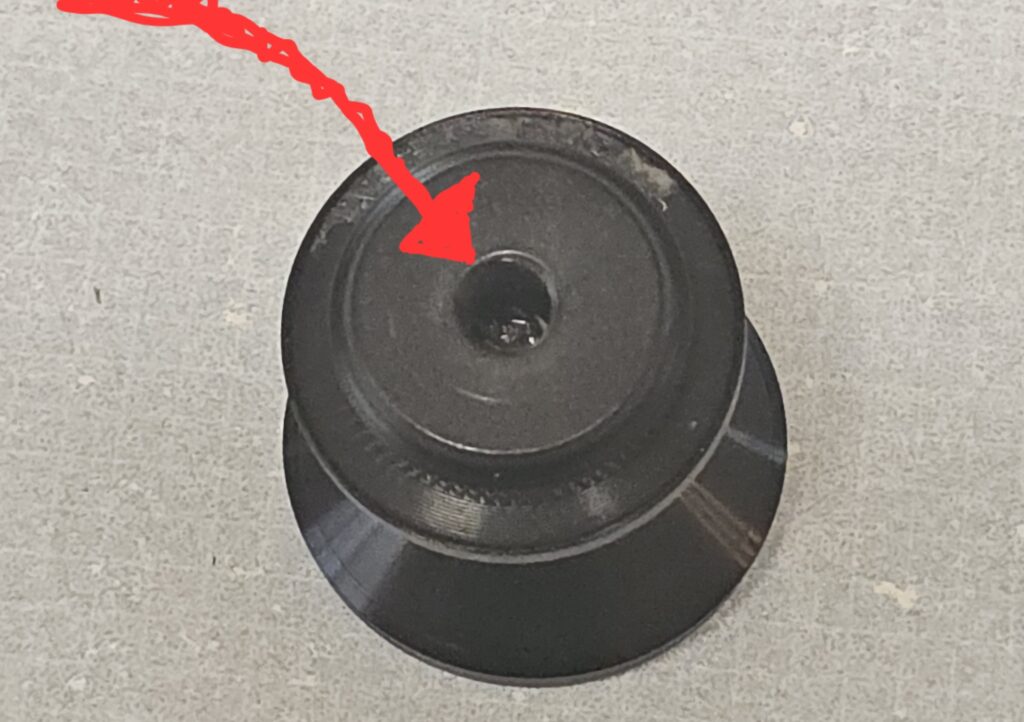
Those four steps should take maybe six or seven minutes. Wait another five minutes before proceeding. The superglue needs a bit of time to cure, especially if you used too much.

Instructions: Assembly

Here’s where you attach the mounting magnet to the arm, and the arm to the cane. It should go very quickly.

  1. Loosen the Magic Arm using the adjustment knob at the elbow. Extend it to be straight, then tighten it back up. This will make everything else easier.
  2. Attach the mount to the arm: Screw the magnetic mount assembly onto the SmallRig Magic Arm. There’s a thumbnut on the Magic Arm already, and it has silicone grippy-rings in it. These should let you screw the mount down securely by hand. The silicone pushes back against the nut “jamming” the threads.
  3. Attach the arm to your cane: Spin the lever on the clamp and open it wide enough to clamp to your cane. Slide it onto the shaft just below the handle, where you won’t be hitting it with your knuckles when you hold the cane. Aim the arm in the opposite direction of the handle, so it points forward when the cane is in use. Tighten the clamp.
  4. Arrange the Magic Arm to reach forward and up: Using the adjustment knob at the elbow, bend the arm up and forward, keeping the arm in the same plane as the cane handle. Note that there are some slots in the ball joints that wil allow more movement in one direction, should you need it.
  5. Mount your phone on the magnet: just place your phone on that mag-mount. Check and see if it’s where you want it. If it’s not, adjust the arm again.
  6. Once it’s all aligned, tighten everything: Screw that elbow knob down as tightly as you can. Tighten the clamp some more. Make sure the mount is screwed tightly to the Magic Arm. Take the rubber band and wrap it around the clamp lever to keep the lever from jiggling and making noise.
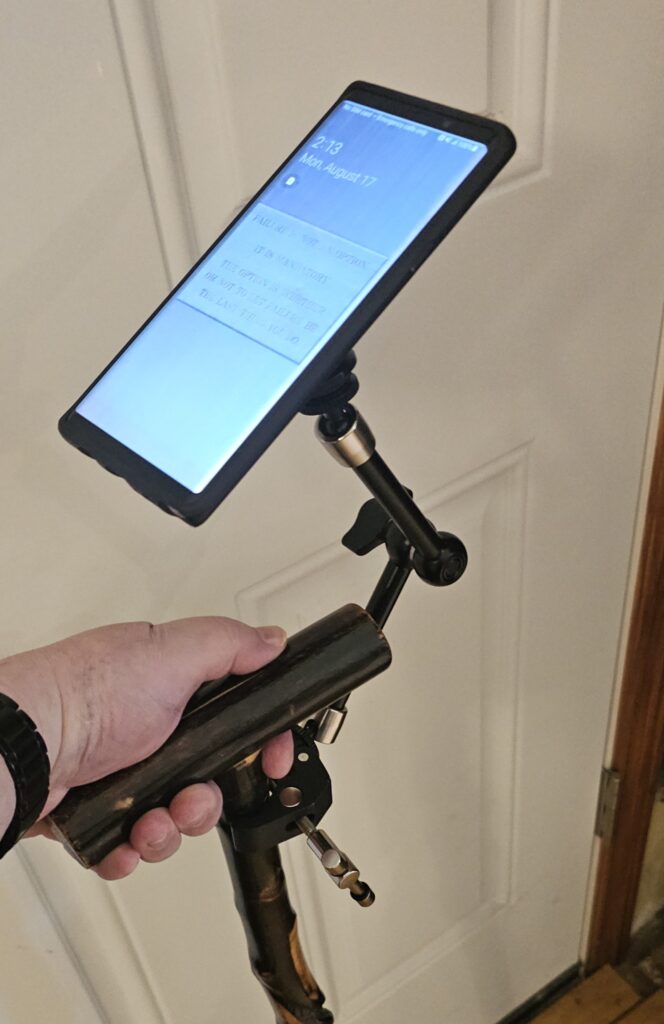
The assembled Type I Technocane. It's a SmallRig Magic Arm clamped to a simple wooden cane. The free end of the SmallRig Arm has a magnet mount on it to hold my phone.

Care and Feeding

Maintenance is pretty simple. Here are the things that are most likely to need attention:

The clamp-to-arm screw. This will tend to loosen over time. You have all the leverage, though. Use the arm as a lever. Tighten the elbow HARD, then lean on that lever and screw the ball joint into the clamp just as tightly as you can. This will take the arm out of alignment with the cane, but that’s easy to fix. Loosen the elbow (which loosens the ball joint, but not the screw), re-align it, then tighten it back up.

The magnet-mount screw. Again, it may loosen over time. Pliers might help here.

The nut-to-mount glue bond. Superglue bonds are very strong, but they’re brittle, and may get more brittle with time depending on the glue, the temperature, the humidity, etc. The easiest way to maintain this is to build a spare. The Coolpow magnets come in two-packs, and photography thumbnuts are maybe a buck each. The good news: I’ve only had one of these bonds fail on me, and I’ve glued at least a dozen thumbnuts to Coolpow magnets.

The Coolpow Magnet: This is a silicone cap over four rare-earth magnets. If you aim this at a big, high-strength bar magnet the magnetism will overpower the chemical and mechanical bond that keeps the silicone cap attached to the cup. This is annoying to fix, so 1) don’t aim your cane at large bar magnets, and 2) build a spare, just in case.

The clamp-to-cane joint: If you have a hollow aluminum, steel, or carbon-fiber cane, that clamp can crush it if you crank the lever hard enough. If you’ve dented the cane by over-clamping, then from time to time you may want to check and see that the cane isn’t deforming further. The failure mode here is the cane head bends or breaks and you fall down. It’s super-unlikely, but it’s worth paying attention to. If you have a solid-core cane (wood or whatever) then this won’t happen.

Field Notes

I’ve been using the Technocane for almost four years now. I built mine using a monopod, and I iterated a LOT before I found something that worked. My personal Technocane is the Mark XII Type II, a carbon-fiber Manbily Monopod with the Magic Arm screwed directly to a hardpoint on the monopod.
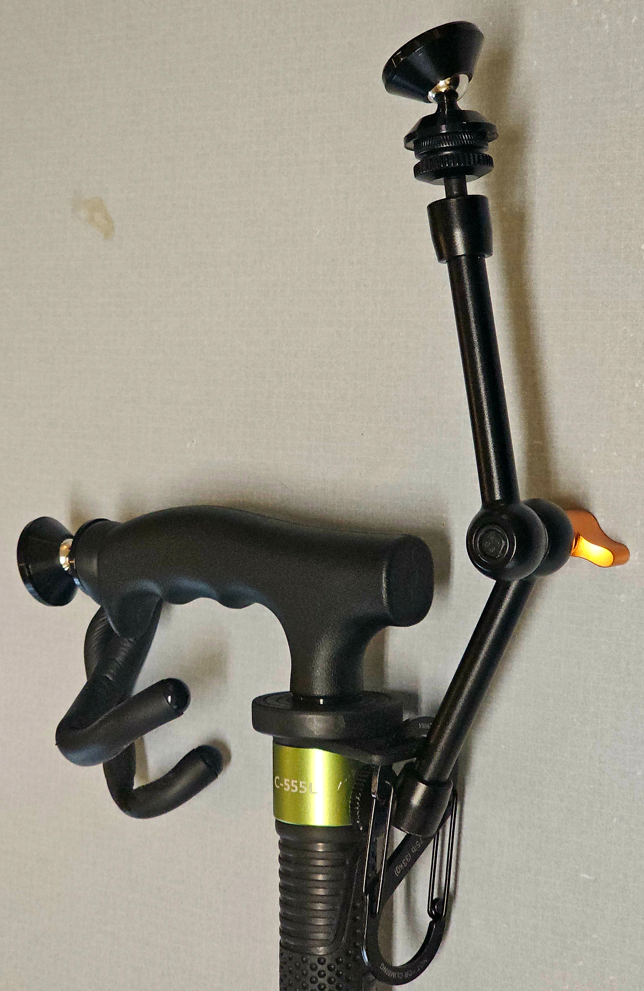
A Manbily C-555L Monopod with the Magic Arm assembly for the phone, a spring-clip for attaching car keys, a padded twist-tie for hanging it over a chair, and a magnet on the handle for docking it against a steel door frame.

“Mark XII, you say?”
Yes. Mark XII. Twelve major iterations before I arrived at the current design. Early on I tried phone clamps instead of magnets, but they failed quite often, and mounting the phone took two hands (not good, I need one hand on the cane to hold me up.) I think I spent close to $800 on trial-and-error before getting here.

I can now build the Type II Mark XII in about 45 minutes, and it costs around $110. Why, yes, I’ve built a spare, and I have a Type I on the bench as well, just in case. See, once my phone taught me not to leave home without my stick, I realized that spare sticks were just as important as spare shoes, or an additional set of car keys.

Is it perfect?

No.

I’ve knocked the phone off the magnet more than I care to admit. Fortunately my magnet-compatible case provides good protection, and if I’m being honest with myself it’s infinitely more likely that I’ll fumble the phone from my hand if I’m trying to use the phone while holding a regular, non-technocane cane.

But I do want to build a fix for the “knock the phone off the magnet” failure mode. I’ve already built it in my head. I just need a machine shop, because this isn’t gonna work with off-the-shelf components.

And that’s beyond the scope of this article. Let’s get back on track.

Brands, Off-Brands, and Substitutions

I listed what I listed because I’ve tested a lot of things. Please, save yourself some time and just use the brand names and the specs I described. Here’s why:

Smallrig & Coolpow vs Other Brands: I’ve used three different brands of “Magic Arm” and four or more of the magnet mount, and here are my findings: Buy SmallRig and Coolpow.
– Smallrig end-pieces, the ones that hold the ball joint in place, are one solid metal piece. Other brands are TWO pieces, and will break when over-tightened, rendering the arm useless.
– Coolpow magnet containment (the silicone cap) is pretty reliable. It has failed me once, and only when I docked it on another Coolpow magnet. Off-brand has failed five times, and three of those were regular use. The cap and the magnets ended up stuck to a steel door.

Metal vs Plastic thumbnuts: Don’t bother with plastic. It’s less sturdy than the glue bond, and plastic degrades rapidly with things like sunlight, air, and time. Anodized aluminum is the way to go.

Superglue vs Epoxy, B-7000, etc: Superglue is easy, it’s fast, and it’s pretty hard to break that bond. Epoxy isn’t as brittle, but it doesn’t seem to grab the surfaces as well. B-7000 is flexible and amazing and don’t bother, it’s for gluing electronics together, not for load-bearing stuff.

Footnotes

¹ I don’t sell anything here. I don’t sell the components, I don’t sell the instructions, I don’t sell the finished product, and I’m not paid for the Amazon links. A cane is a medical device, and is rightly subject to all sorts of product testing, registration, and licensing. I’m not in the medical device business, and you don’t need me to be, because you can build your own without worrying about that.
² The Coolpow mount is not designed to work with cases that allow for cordless phone charging. Mounts that ARE designed for that use a ring of magnets, and require phone cases with a similar ring that goes around the charging coil without interfering. If you can find a mount like that with a base that can be glued to a thumb-nut (or that already has a 1/4″x20 screw hole), then you can use that instead.
Hello, 2026, Let’s Look Back at 2025

I spent much of 2025 the way I spent 2023 and 2024: bulldozing speedbumps.

It’s a metaphor I’ve deployed before. It means “identify things that create extra work, or stress, or pain, and remove them.” The full metaphor goes something like this:

Before Long Covid¹, I was like a fast vehicle with a very robust suspension. Speedbumps, rough road, and even obstacles were things I hit at full speed, powering over them or through them. Sure, I tried to work smarter, but working HARDER was always an option.

Now, however, I’m disabled. I’m more like a late 1960’s station wagon with the original shock absorbers. Also, the back of the vehicle is full of boxes of glassware, none of which has been packed with proper padding. When I see a speedbump, I don’t just slow down. I stop.

I get out of the vehicle, measure the speedbump, then bring in a bulldozer to scrape it off my road. While the heavy equipment is out I check for potholes, and take care to repair all the pavement in sight.

This slows me down a lot, but it also prevents me from crashing, and the word “crashing” nicely links the metaphor to the lived experience. PEMS (Post Exertion Malaise Syndrome) is part of my life now. If I push too hard, I crash. I get weak, everything hurts, my mental state degrades, and if it’s a bad enough crash I will actually run a fever and end up in bed.

So… by 2023 I had internalized this process. I built systems to make my life easier. Very shortly into this process I decided to build systems to make building the systems easier, and that shaped 2023, 2024, and 2025. I designed, built, and refined the Technocane (I taught my cane to carry my phone so my phone would teach me to carry my cane) and the Gravistation (a zero-gravity recliner surrounded by every last tool I need to write and illustrate)².

2025 felt like mostly smooth road, but from that easy-riding perspective I was now able to see the roads I’d been avoiding. I decided to tackle some of those. There were some refinements to the Technocane and the Gravistation, but most of my effort went into the kitchen.

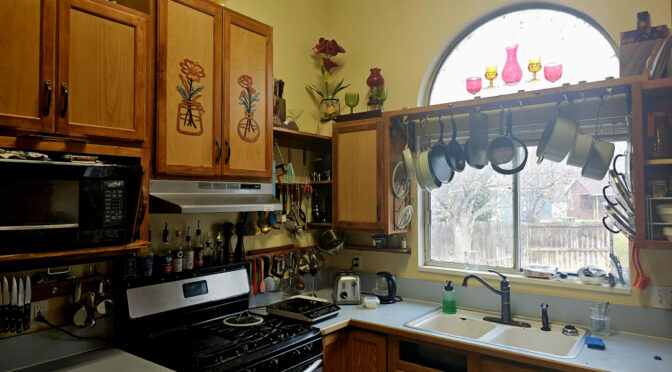
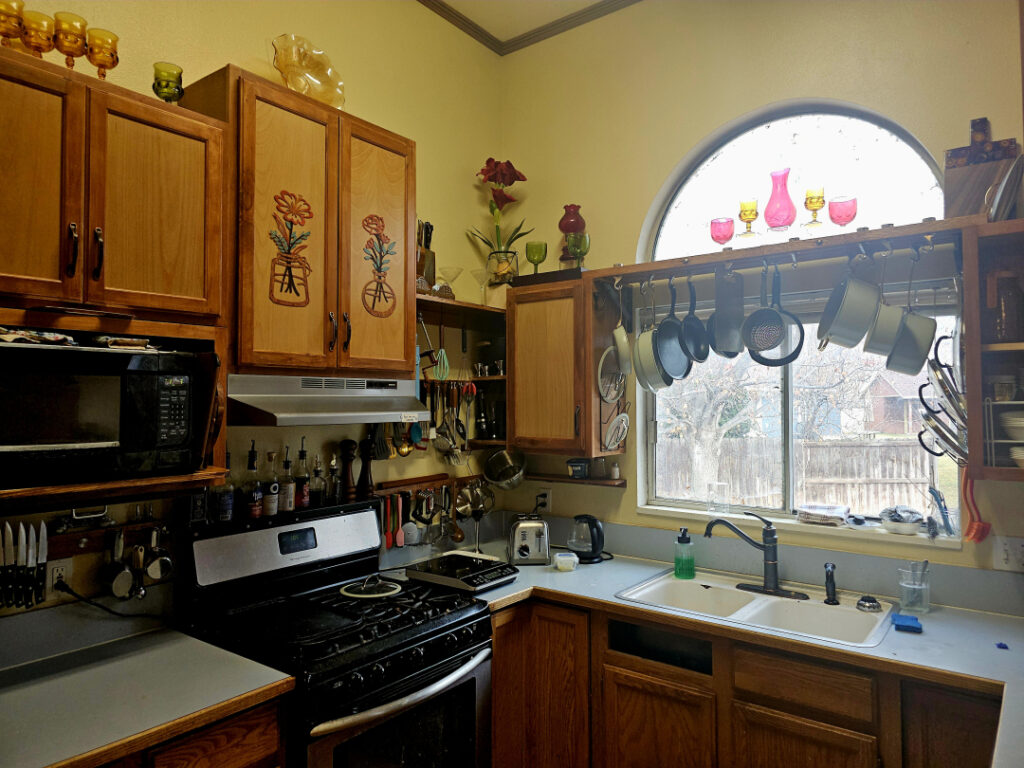
One corner of a very well-organized kitchen. Pots and pans hang on rails over the sink, and cooking utensils hang next to the stove. The cabinet faces are decorated with floral appliques, and colorful glassware is displayed on top.
The upgraded kitchen, as of January 2026.

There were two reasons for this: first, Sandra has some new nutritional requirements³ and I needed to up my cooking game to address those. Second, I like to cook, so I should to make that process as speedbump-free as possible. That way I can cook and still have the energy to do other things later in the day.

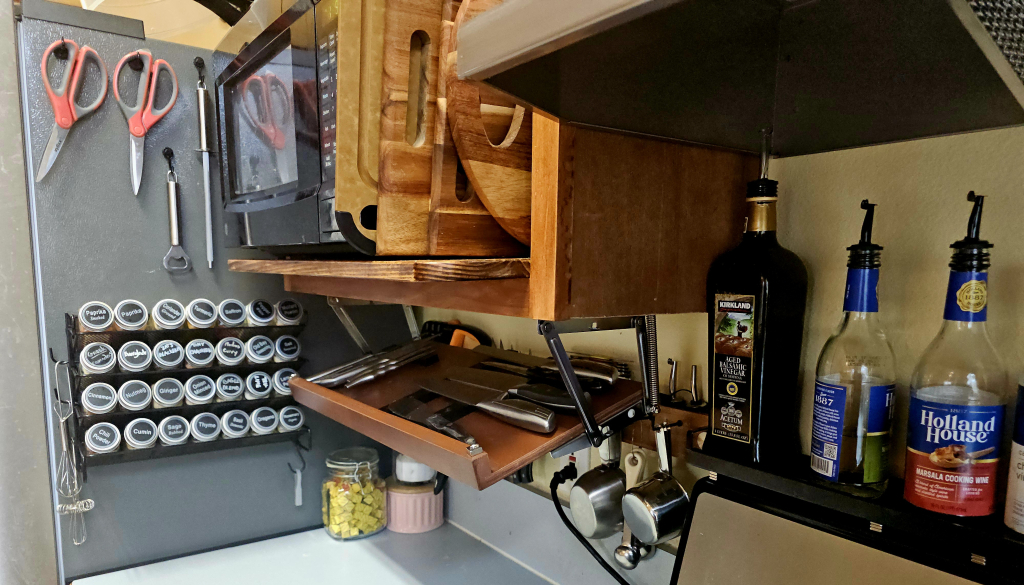
Another corner of the kitchen. A spice rack is magnetically mounted to the side of the refrigerator, with 28 uniformly labeled spice bottles. A drop-shelf is partially lowered from its position beneath the shelf supporting the microwave. The drop-shelf is for knives, all magnetically-docked where they can be hidden and secured from youngsters.
The spice rack, the drop-shelf for the knives, and other easy-to-reach, often-used things.

At Gen Con Indy we learned I can work a covention booth without being reclined the entire time, provided I have a comfortable kneeling chair. I did need to work on my posture and my core strength a bit, so in September we decided to rebuild my craft station (unused for almost five years) so that I could train for conventions while painting miniatures.

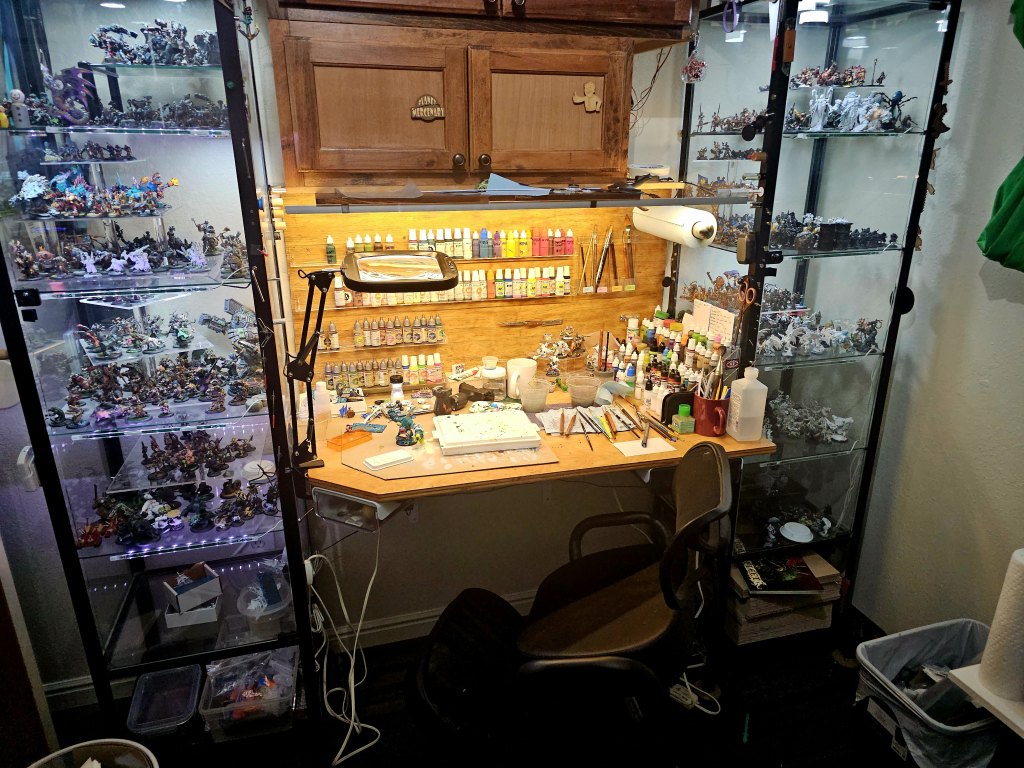
A well-lit crafting station with paints on racks on the wall, freeing up table space for the wet palette, water jars, and more. The table is bracketed by a pair of glass display cabinets full of tabletop miniatures. A kneeling chair sits in front.
The crafting station, totally cluttered, with the kneeling chair in front of it tempting me to go paint instead of finishing this blog post.

This was a huge success. I painted around 140 minis from September through the end of the year, and now I’m quite comfortable working from a kneeling chair.

Working… let’s talk about that. After all, if you’re reading this it’s probably because you’re most interested in the work I do. During 2025 we finished the last of the shippable bits for the MANDATORY FAILURE Kickstarter project (book sketches and marker-colored sketch cards) and I dove back into the core deliverables for FUNCTION OF FIREPOWER, starting with the Bonus Story, “Refulgence of Refuge.”

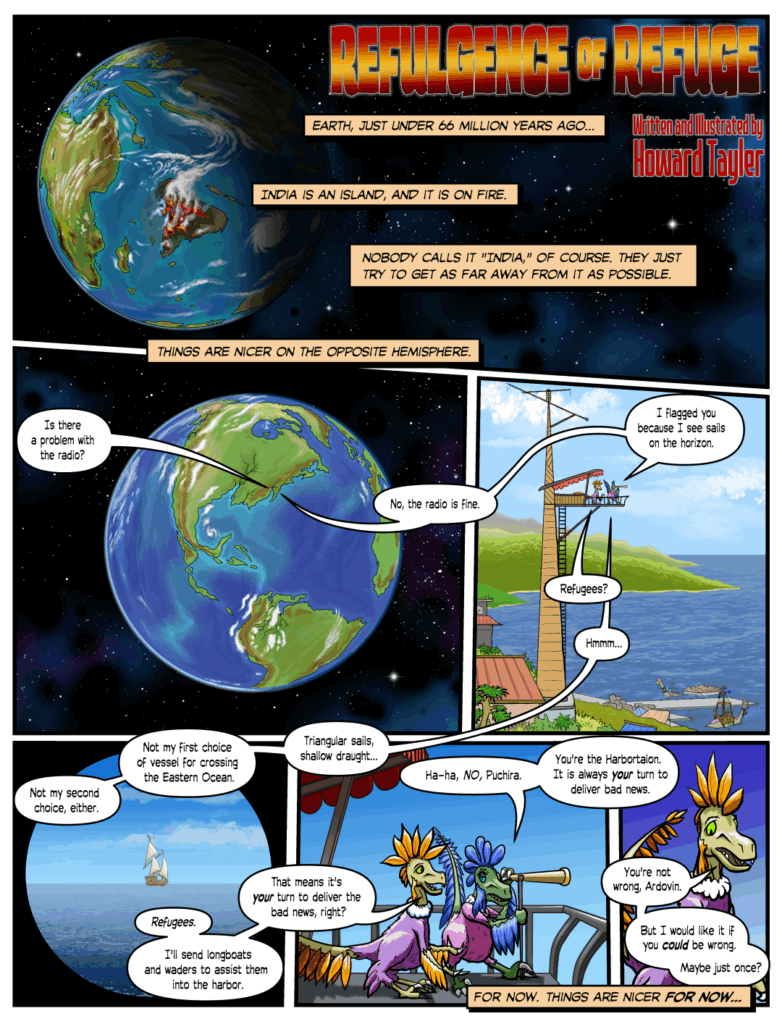
That story deserves its own blog post, because it’s a really cool story, and the story OF the story is still unfolding by virture of the fact that I’m still drawing the pictures. Until then, here’s a picture.

A work-in-progress page from a comic book. The narration and dialog tell the story of Earth 66 million years ago, and the feathered, raptor-oid dinosaurs who built a radio tower.
Page 1 of “Refulgence of Refuge.”

So… that’s my 2025 round-up, along with a bit of insight into what 2026 will hold. I have more to say about (and during) 2026, but this is running long, and I haven’t even added the footnotes yet⁴.

———

¹ I’ve talked about this before. tl;dr—I got sick during Wave Zero in early 2020, and now I have Long Covid, which manifests mostly as chronic fatigue.
² In 2024 I promised that I’d publish all the details on the construction of these things. I still haven’t done that, but I have all my notes. We even filmed a video of me building a new Technocane in 2025. So… I’m working on it.
³ EOE, which we’re addressing with 6FED. Unpacking that would be a three-page footnote. But now you have the acronyms, so you can upack them on your own.
⁴ Okay, that was a half-truth. I’d already written and formatted the first three footnotes. I write those as I go. But I hadn’t added THIS one yet. I guess that means it was more like a ¼-truth?

The Sketching Begins!

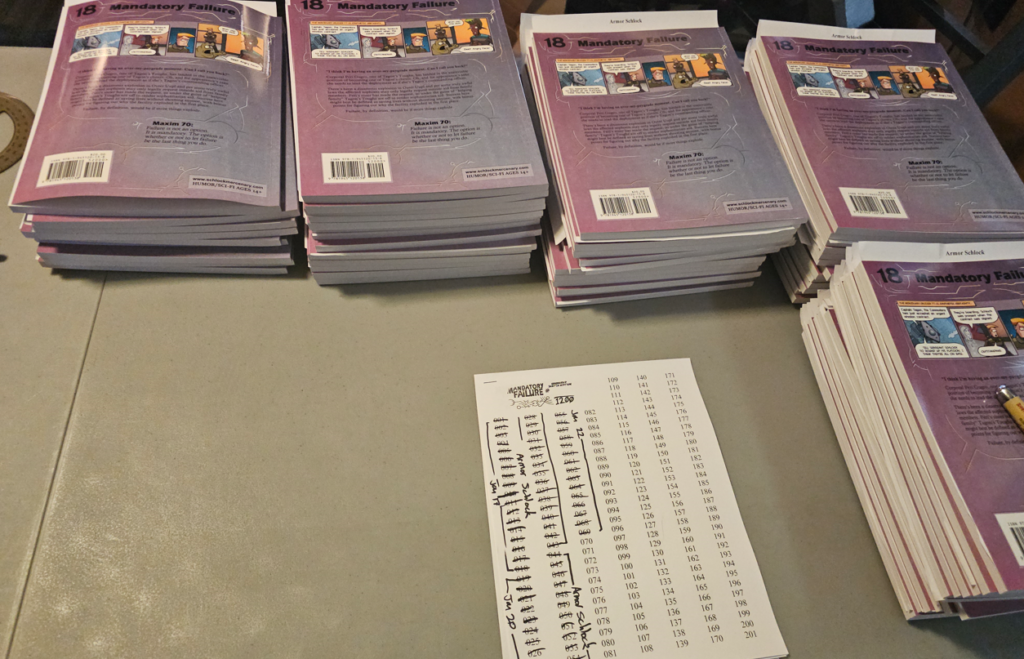
Book 18, Mandatory Failure, has arrived from the printer. I’ve signed about 2500 copies, and we’ve begun queueing those up for sketches.

A few stacks of MANDATORY FAILURE awaiting sketches from Howard

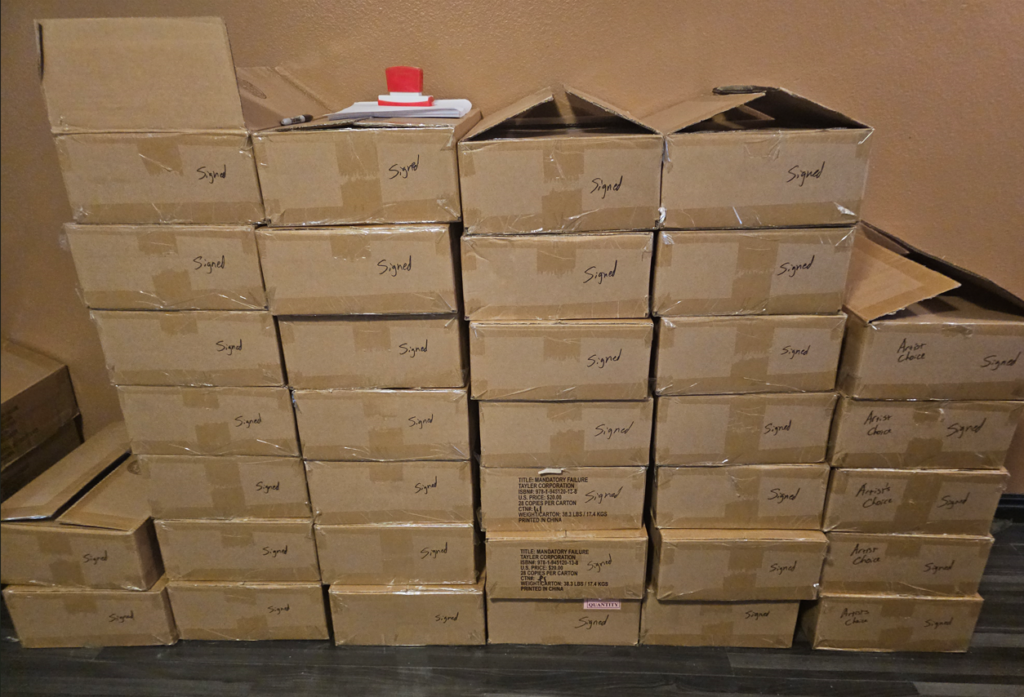
My stamina is not what it used to be. I’m as fast as ever, but I wear out pretty quickly. Slow and steady, then. If you’ve ordered a sketch edition, it’s in one of these boxes stacked against the wall, and it might be waiting there for a while…

Twelve hundred books. It’s a good thing the sub-floor in this room is solid concrete. Books are heavy.

I’m also doing sketch cards for some of you. I’ve finished about 200 of those already, and another 270 remain to be done. Those take longer, but I can work on them from my zero-gravity recliner, which lets me work for much longer stretches.

How long will you be waiting for your sketched book? I do not know! One thing that I learned in 2024 is that I need to recalibrate my estimates. I promise you this, though: I’ll work on these every day, and I’ll pace myself carefully.

2024 In Review

How did 2024 go for me?

Well, the beginning of the answer to that question can be found in the date of this post. We’re two-thirds of the way through January and I’m only now finding the time and energy to write a year-end thingy.

The end of the answer is a bit bleak. In summary, I learned that I’m more disabled than I thought I was. I still make big plans with high hopes, but then I overdo it and end up “soft” crashing for weeks at a time. This has delayed everything, including the release of Book 18, which we originally planned to be shipping six months ago.

The middle of the answer, the meaty part, would be a retrospective itinerary of sorts, and I’m not sure I have the energy for that kind of detail.

The high points: I finished everything that was keeping Book 18 from being sent to the printer, and I started working on the Bonus Story for Book 19. I attended GenCon Indy, WXR 2024: Write on the Navigator, and Dragonsteel Nexus. I learned to prepare a wide variety of 6FED-friendly meals for Sandra, and because necessity is the mother of invention I invented a no-egg mayonnaise.

One thing I’m quite pleased with: I spent very little time adjusting, revising, or re-working my zero-gravity workstation. Similarly, I didn’t need to iterate my Technocane. I probably put 300 hours into those things during 2023, and those hours began paying dividends in 2024. I learned that there is enormous satisfaction to be found in consuming the fruits of a job well done.

I wish I’d done more, though. I planned to do more, but the chronic fatigue aspects of Long Covid are, to me, the plow described by poet Robert Burns when he bemoaned the state of the best laid plans of mice and men. My plans were big, but were mouse-sized compared to the churning, earth-moving disruption of this disability.

Bleak, perhaps, but let me play a hopeful note as we return to the end of the answer: I learned a lot about my new limits during 2024, and I began arriving at strategies to make the most of the narrower space within which I must work. I won’t make any promises for 2025, not yet at least, because one of those strategies is learning to take things day by day.

Today has been productive for me. I haven’t done all of the things, but even at my healthiest I was never able to do all of the things. I can accept that. I have learned to take the win, and then take a break.