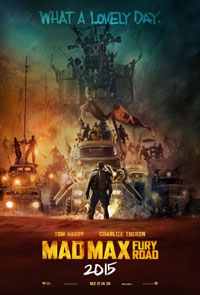
Mad Max: Fury Road

This is the Mad Max movie I didn’t know I had always wanted until I saw it. Tom Hardy plays Max as crazy-mad instead of angry-mad, and it’s the “seeing things that aren’t there” crazy instead of merely being angry with grief (though, he’s that too. And unhinged.) Also, we see him employ some skills beyond simply driving, taking a beating, and shooting things (though he does plenty of all three of those.)

MadMaxFuryRoadMax’s world is a familiar sort of wasteland, but it has an economy of sorts, requiring a bit less suspension of disbelief. Which is good because we’ll need that stuff for more important things than “how are people still alive at all?”
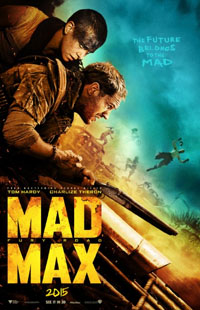
Plot-wise, I loved how the fairly straightforward, convoy-on-the-run story has some actual, human motivation beyond “let’s steal gasoline.” I say “fairly straightforward” because there are a couple of twists in there, but I liked them, too.

MadMaxFuryRoad-img2I’ve heard that some folks are complaining that Charlize Theron’s character was somehow too bad-ass, and was upstaging Max. I looked for that, and am happy to report that Max was every bit as awesome as I hoped he would be. If his star seems to shine a little less brightly, it’s because that wasteland is chock-full of crazy-capable bad-asses (including Theron’s Imperator Furiosa,) which makes sense since these are the people who are still alive.
Still alive at the beginning of the movie, anyway.

I love comprehensible action scenes, and MM:FR was full of them. The camera gives us several “savor the moment” shots where the action is so iconic we need to slow down a bit and soak it in before the flames and the dust muddle it up.

The post-apocalyptic aesthetic of the film has its roots in the original Mad Max film, obviously, but that aesthetic has passed through a number of hands over the years, so that by the time it arrives back home in the Mad Max franchise you can taste all kinds of things in the dust, including Fallout: New Vegas, Defiance, and Borderlands. I did not hate that one bit. If Gearbox ever makes a Borderlands movie, I expect it will look like Mad Max: Fury Road with better weapons and more hockey masks.

Mad Max: Fury Road comes in at #4 for me so far this year, clearing my Threshold of Awesome with room to spare. Extra headroom was added by the guy playing a flamethrower guitar while chained to the  front of a stack of speakers on top of a vehicle that has an entire kettle-drum battalion banging away in back.

(That dude convinced me that post-apocalyptic role playing games have room for a bard, provided he has an electric guitar that shoots fire.)

Seventy Maxims, at Long, Long Last

Let’s say, just for the sake of argument, that you’re not interested in the Planet Mercenary RPG. How could I possibly tempt you into that Kickstarter? What product could be sufficiently enticing to bring you over to our project page and enter a pledge?

The answer? Provide something that I’ve been anxious, thrilled, and quiveringly-excited about for months now:

The Seventy Maxims of Maximally Effective Mercenaries

We have a pledge level for the Seventy Maxims book.

This isn’t just 70 pages of aphorisms. It’s not something that would fit in the wiki, or on a poster. This is the hardback version of Karl Tagon’s personal copy of the 3001 CE Edition of The Seventy Maxims of Maximally Effective Mercenaries.  This is an in-universe artifact.

To introduce you to it, here is a block of text from the introduction:

In 2992, in a speech to the CDF Acadamy graduating class, Rear Admiral M. Randall Aarikaida dismissed the book as “an irreverent, irresponsible volume of malevolent canon.” In that same speech, however, he paraphrased maxims 9, 15, 35, and 70 without attribution, unconsciously cementing its importance in the field, and launching countless dissertations which focused on the cultural ubiquity of the very thing he was dismissing.

This edition serves as a distillation of that scholarship. The maxims are accompanied by commentary and corollaries, paraphrased, and in many cases translated from the original, unintelligible jargon so that the modern reader might grasp the essential point. By so doing we’ve made this book more accessible, and more affordable because now we don’t need to pay any of those scholars the ridiculous royalties they demand.

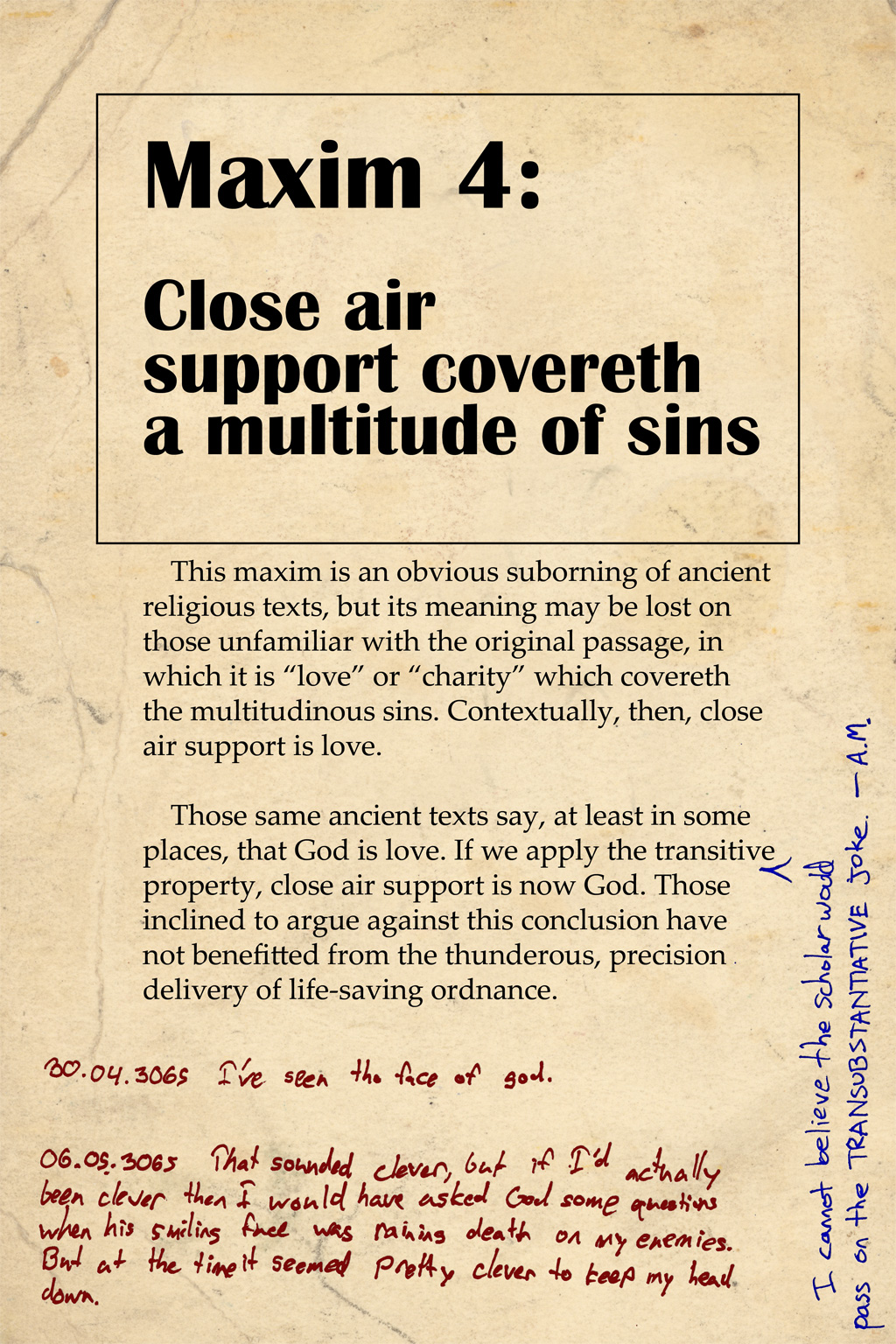
Barring handling them for yourself, the pages themselves are best experienced with an image:

This page is one of our early proof-of-concept versions, but it shows off the spirit of the thing. Don’t worry: the paper we use will NOT have a printed weathering on it. The weathering in this image is there to evoke the fact that we’ll be using a very toothy, heavy paper with a cream color to it.

The boxed text contains the maxims themselves. The text below that is “schlolarly commentary” which, as suggested by the excerpt above the image, is going to be all over the map.

The red-pen notes are from Karl Tagon, who acquired this book as an enlistee in 3044. His sergeant at the time told him he should use it as a journal of sorts, and so we’ll get an unordered series of snapshots of his military career. Paging back and forth to put the notes in order will be part of the joy of having this in hard-copy.

The blue-pen note above is from Alexia Murtaugh, to whom Karl loaned the book. (Well, “will-have loaned.” That bit of story has yet to appear on line.) While the book is in Murtaugh’s possession it is going to get picked up and scribbled in by a few others, including Sergeant Schlock.

We will leave room for you to write in it yourself, of course.


Note: PDF and eBook development is a project for another year. The final product wants to be rotated in your hands, dog-eared, thumbed through with multiple fingers holding your places.  It is not impossible to translate the experience into a purely electronic format, of course. Just time consuming. For now, we’re offering an in-universe artifact that is meant to be handled, and left out for guests to marvel over.

“Build me a prototype, dear.”

Alan and I have a plan for Planet Mercenary Game Chief screens, and it involves building something more modular, expandable, and ultimately more useful than the traditional tri-fold (or quad- or quint-fold) screen that has become the industry standard.

I bought some plastic clips and some comic book backing board, envisioned what I wanted, and ran into a conflict. I wanted to spend several hours making comics today, AND I wanted to spend several hours building a really cool prototype.

My twenty-year-old daughter Keliana, home from school where she’s majoring in illustration, was awake and exploring breakfast options in the kitchen.

“Hey, K. Can you build a thing for me?”

“What kind of thing?”

“You’ll need the mat cutter, some spray paint, my hot-wire knife, my sculpting tools, and probably tape and glue. I want to make this—” I pointed at the stack of backing board and clips “—look like this. ” I held a map pin up at the corner of the screen of my Chromebook.

“Okay, I can see it…” she said.

“I’ll make a steak quesadilla for your breakfast, and you’re on the clock for whatever Mom’s paying you as of the word ‘go.'”

“Tenderloin steak?”

“And green chiles, fresh tortillas, and green onion.”

“Go.”

As I write this, Keliana is upstairs taking a hot-wire knife to some clips that are *almost* the right shape. We’ve finished off the quesadilla, and now I can dive into making comics while reveling in the fact that a minion who once was barely useful enough to do dishes can now be handed a complex project, and can trusted to make it beautiful.

It’s been a long time coming. Also, we had to increase her allowance to the point that she gets a W2 at the end of the year.

Galavant: Just Buy It Already

My oldest daughter came back from college and told me I needed to see something called “Galavant” on the television. We don’t do cable in my house so I Youtubed some trailers, got hooked, and checked it out on Amazon Instant Video.

Galavant is a trope-ridden medieval fantasy comedy musical. How such a thing existed without me knowing about it without the help of my children reflects poorly on me.

If you enjoyed the musical episodes of Buffy and Community, if you sing along with Doctor Horrible’s Sing-Along Blog, you should buy Season 1 of Galavant on one of the services where it’s available (Amazon, Google Play, and iTunes.) I bought the HD version on Amazon and have now watched the whole thing three times through.

I’m not a fan of the streaming model, where I pay “own the whole thing” prices, but can’t actually watch unless I have a persistent connection and a DRM-ish browser window. Galavant is good enough that I’m perfectly happy to tell myself that I paid $20 to rent it. I got 176 minutes of great programming. I’ve spent more than that for movies half that long, and no lie, if Galavant were a theatrical release I would rank it above everything I’ve seen so far this year, including The Avengers. In fact, I came home from The Avengers excited to hurry up and write a review so I could watch Galavant.

Seriously, when it comes out on Blu-Ray I’ll probably buy it again.

Am I gushing? Yes. I don’t do this often.

Writer, Illustrator, Consumer