Gemini Cell by Myke Cole

Myke Cole burst into my reading queue when I met him at Lunacon in 2012. I devoured his debut novel, then waited patiently for the follow-ups, which I consumed with aplomb.
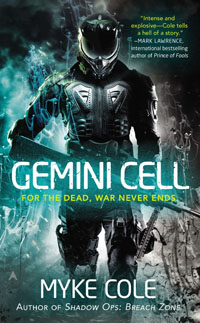
GeminiCellGemini Cell is Myke’s fourth foray into the 21st century’s “Great Reawakening,” a setting in which magic has come back into our world, and the military’s best and brightest have blended it with modern warfare to create squads, platoons, companies, and entire battalions of trained, disciplined, and sorcerous soldiers. Which is good, because their enemies are every bit as well equipped. It’s a compelling setting, but this time around we’re seeing it differently.

In Gemini Cell we get to see the beginning of it all. Our protagonist is a SEAL at the top of his game, but it’s a completely non-magical game, and he has no idea that his current operation will cross paths with a magical supply line.

The story is a powerful one, and to my eye it takes some oft-maligned tropes of military adventure fiction and shows us how those things are supposed to be done, especially the “prequel” trope. That might technically be what Gemini Cell is, but it stands quite well on its own, inviting an immediate sequel or two while leaving plenty of room for the extant Shadow Ops series.

Gemini Cell releases on Tuesday, January 27th, 2015.
How My Project Budget Works

In 2014 I created a spreadsheet for project management that allowed me to be a little more realistic about what I can and cannot do. The result was that I had a very productive year in spite of losing four full work-weeks to influenza, and we went on to deliver two books, two slipcases, and a calendar in time for the holiday shopping season. And that last bit? That’s kind of a big deal when it comes to the bottom line here.

I’m doing it again in 2015. Here’s how it works:

  1. I carve my time up into twenty-hour blocks called, intuitively enough, “half-weeks” of work.
  2. I make a list of projects, and I guess how many half-weeks each of them will take. A convention weekend is a half-week. A big convention like GenCon Indy is a full week. The Writing Excuses retreat was 3 half-weeks, and I budgeted exactly right that time. Each project becomes a row in the spreadsheet. Each is assigned a priority based on the month in which it needs to be complete.
  3.  I include the comic, 52 weeks of which will take 52 half-weeks of work (This assumes that I’m able to bang out a week of strips in 20 hours. This is increasingly an unsafe assumption.) This got a priority of 9, because I needed it at the bottom of the list. I know that one has to get done each and every week. Duh.
  4. Oh Magog, the math. The spreadsheet balances my projected half-weeks of work, and subtracts it from the pool of 104 half-weeks in a year. The spreadsheet then tells me that I have too much on my plate, so I revise the estimates or prune projects. This happened in January of 2014, and after careful revision I had a year’s worth of work that fit inside a year, except that 8 months of work needed to fit inside of 5 months. But I could SEE this, and knuckle down accordingly.
  5. Each week I update the amount of work remaining in the tracking column for each project, and I input which week of the year it is in a cell that determines the size of the pool of remaining half-weeks. The spreadsheet then automatically calculates the balance, and usually it tells me that I need to cough up 60 hours or 80 hours of work during an upcoming week in order to catch up.
  6. I color-code the projects based on whether they’re scheduled items (Conventions or vacations that chop time out of my schedule), and whether they’re complete (lime green, with grey text — these are items I don’t need to look at or be distracted by, because DONE!)
  7. The spreadsheet sits in my Dropbox where I share it with Sandra. She can review it and see how I’m doing. She can also update it, though she never actually did that.

I know there are other tools for project management, but when I looked into them I realized that the amount of time I would spend learning how to work something I paid for was about equal to the amount of time I would spend building a spreadsheet I knew innately how to use, and could quickly reshape to fit the way I want to plan things. I don’t have a sanitized version of the spreadsheet to share, but maybe at some point I will.

Over Budget and Overbooked

I just put together my project budget for 2015. It’s a big spreadsheet that describes how I’ll spend my time during the year. It includes things like the events I’m attending (each of which chews up a bunch of work time, just like actual work would) and “steady-state” stuff like making 52 weeks of comics (except I need to make 54, because the buffer’s a little thin.)

Good news! I know how to budget! Bad news… I’m 9 weeks over budget. So I guess I’ll just have to shoehorn an additional nine work- weeks into 2015, because obviously I’m not going to stop doing any of these cool things we’ve got planned.

It’s 2015! Hello, Back to the Future, Part II

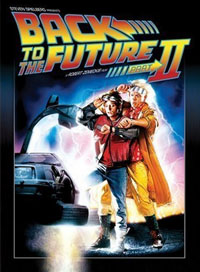
We watched Back to the Future, and then BackToTheFutureIIBack to the Future, Part II with our kids last night. The 2015 imagined by Robert Zemeckis was a satire (of course,) and lots of people have discussed where it hit and where it missed.

It was particularly interesting to watch my kids react to the film. Flying cars and hoverboards? Very cool! Self-drying clothing? Don’t be silly. People sitting around a microwave pizza engrossed in the programming on their wearable devices? Well, duh. Why’s that scene even THERE? We know THAT.

Remember the bit where Marty, Jr. watches six channels at once on the TV? My kids shrugged. Six is kind of silly. They max out at two or three — YouTube in one window, and a sandbox game like Minecraft or Terraria in a another,  and a play-through video in a third. Why would you do six if none of them are interactive?

All that aside, they liked the film, and they’re really looking forward to the third one at some point today. Me, I remember being kind of upset at the “downer” ending of Back to the Future Part II, and my memory of it was Marty standing in the rain. No, it ended with Doc Brown saying “Great Scott!” and then fainting, and those last moments of the film were far more enjoyable than I remember them. Maybe the films of the last 15 years have reprogrammed me to enjoy middle-act endings.

I could be wrong, but I think the big thing that Back to The Future Parts II and III gave us was a rebirth of serial cinema. Without their commercial success, Hollywood wouldn’t have greenlit Peter Jackson’s Lord of the Rings trilogy, and comic-book movies might still be what they were in the 80’s. Hollywood thought Zemeckis was crazy at the time. I’m glad he had Spielberg on his side, because I’ve loved the serial cinema of the last 15 years.

Writer, Illustrator, Consumer