Lock In, by John Scalzi breaks a couple of big rules, but gets away with it quite handily.
 It’s near-future science fiction in which a plague has created a whole new class of people whose minds are in fine shape, but who have no ability to move their bodies. They’re “locked in,” and as the prologue (okay, THREE rules) tells us, the fact that some very high-profile people get locked in results in hundreds of billions of dollars in emergency research, several breakthroughs, and a cool system whereby these folks can function like normal people — they teleoperate robot chassis, and yes, this causes some societal upheaval.
But that’s the prologue, and I’ve left lots of stuff out. The story itself is part mystery, part sci-fi police procedural, and part technothriller, and covers a lot of ground in some very efficient words. It’s fast-paced, and I found it really engaging from the beginning all the way to the end.
The book felt kind of thin on descriptions. It’s not quite white-room, but it depends heavily on the fact that the readers can be depended upon to fill in a lot of blanks with their own experiences — something readers are going to do anyway, really. It’s near-future SF, so it’s not much of a problem, and Scalzi gets away with this on the strength of the book’s pacing. Rich descriptions would have broken the pace, and besides, he describes the important stuff.
The big issue for me was that the main character did not have a compelling arc beyond getting the mystery solved and keeping his new job. I gave this a pass for a couple of reasons: first, the story is more of an Idea and Event story than a Character story. Second, the main character is a Lock In, and the fairly shallow character arc makes him seem normal compared to the people around him. Sure, he wants the same sorts of things that you and I want, but he’s not a cop on the edge, or a rookie with a dark secret, or any of the other plot-shortcut tropes.
So I guess it’s not a big issue. It only came up when I got to the end and realized that although the end was satisfying, the main character’s journey wasn’t really about him at all.
The book has already been picked up for a TV series, and I think that it’s kind of perfect for that. There are plenty more stories to be told in the Lock In universe, and they’re good, thoughtful stories that a competent screenwriter can wrap up in 43 minutes, or can wrap a season of 43-minute episodes around.
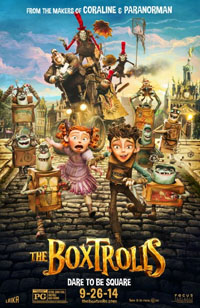 The Boxtrolls is quirky, funny, dark, and a little disturbing in all of my favorite ways. I enjoyed it, but I can see lots of places where folks might not think it’s their thing. Then again, there are probably other folks who will love it a lot more than I did. It comes in just a hair below my Threshold of Awesome.