Remember those Facebook hoax-posts in which people would decry Facebook’s plan to charge its users a membership fee? There’d be some misdirected outrage, and then someone would clear things up by saying “no, Facebook is not planning to do that.”
I wish they HAD been planning to do that.
Facebook’s actual plans were far more problematic. At a high level, the plan was to monetize their user base as a product, rather than as customers. This meant selling the product to OTHER customers—advertisers and market research firms, for starters. I don’t mind being advertised to, but in order for the monetization to work, Facebook had to step into our feeds and adjust the content we were seeing.
Facebook became less useful to us, and this loss of utility was hidden much of the time. When we actually noticed it, it was status quo.
Twitter is doing similar things to monetize their user base. The insertion of Promoted Tweets is the most immediately intrusive, but recently they’ve begun mucking with our timelines in order to adjust the content we see.
Look, I get it. These companies are providing an exceptionally valuable communication service to hundreds of millions of users. They deserve to be paid for that. The question is, what’s the best way to pay them? What will make them the most money, while keeping their users not just happy, but loyal?
Twitter’s 2014 revenue was $1.4B. They have over 900 million users, but most of those users do not tweet things. If we assume, conservatively, that there are only 100 million human beings actively using Twitter’s service, they were worth $14 each during 2014. Much of that money was paid in by advertisers.
$14 isn’t much. It’s less than $1.20 per month. I would cheerfully round up, and pay $20 for an annual Twitter membership without batting an eyelash.
For that money I would obviously expect to NOT be monetized further. Don’t market to me, don’t promote Tweets, don’t mess with my feeds. Maybe give me instead some cool tools that let me better manage this awesome communications tool.
If those 100 million users were willing to pay $20/year for “Twitter Prime,” Twitter’s revenues would be $2B. It’s not beyond the pale to further assume that their profit margins would be better, since all the overhead that goes into making a useful advertising engine could be dust-binned. Additionally, Twitter would become far more valuable to its users (who are now CUSTOMERS,) and they’d attract more paying users pretty quickly.
In the grand scope of Big Business and All Things Internet, two billion dollars is chump change. That money would not turn Twitter into a financial powerhouse. Of course, neither will their current plans, so “displace Google” is a business goal that should be swept off the table.
Ultimately, the social media business model needs to change. Consumers of social media should be able to become customers, not by purchasing “eyeballs,” “likes,” or “followers,” but by purchasing better access to the actual social media services; services that would better serve those who use it.
I cannot conceive this discussion NOT having taken place somewhere in Twitter’s offices. What I don’t understand is the business requirements that shut that discussion down, preventing them from selling me a decent service.
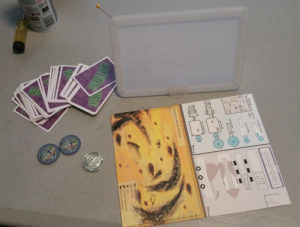 The prototype is a high-res 3D print, so the plastic is translucent instead of opaque. It’s designed to take half-sheets of US Letter sized paper. A full sheet of US Letter, printed with some game map stuff, is shown in the picture above.
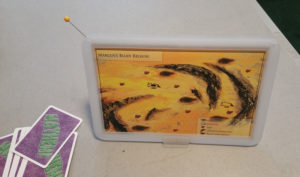 After folding that sheet in half, it drops into the screen quite cleanly.
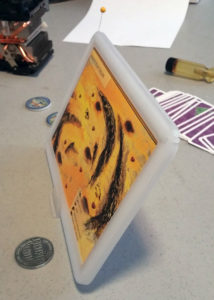 Here’s a better look at the angle. For scale you can see a challenge coin, a couple of poker chips, some playing cards, and a pair of AMD CPU fans, stuck back-to-back because they look cooler that way (they were not cool enough when mounted in the PCs, and have been replaced with off-the-shelf liquid cooling rigs, making our game room much, much quieter, but I digress…)
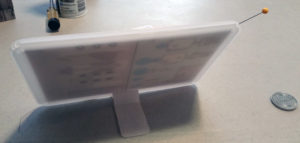 Here it is from the back. The fiddly-bit sticking out of the corner is a yellow map pin from the local office supply place. Note that the final product will not be translucent enough for anything to be visible through the back.
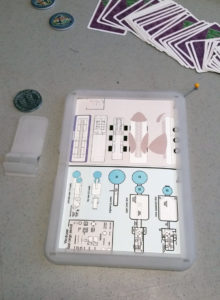 Obviously it needs to store flat, so the stand detaches quite nicely. As an added bonus, this means you can put a note, or other mission-specific information into it, and pass it to the players, just like the characters in the comic do with their their handbrains.
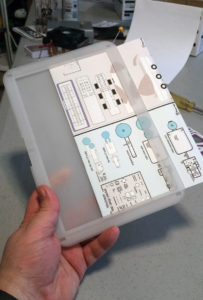 Sliding things into and out of it is quite easy. If your game is anything like the ones I’ve played, this is a critical feature.
 I love dinosaurs as much as the next person, but I was concerned about the concept for this film. Admittedly, this is mostly because to my mind any alternate history that’s missing the Chixulub impactor will also be missing any mammals larger than a rat, and certainly won’t feature sapient hominids, but the concern is there nonetheless, even if it’s just me.